
Understanding Solar-Powered Security Cameras
What is a Solar-Powered Surveillance Camera?
“The sun never clocks out,” I tell the night, and that belief powers a solar panel security camera that watches over South Africa’s sun-drenched neighborhoods. In practice, daylight becomes energy, and energy becomes a tireless guardian that keeps records during load shedding and after dark. This off-grid sentinel blends mythic resilience with modern optics, turning bright days into round-the-clock vigilance!
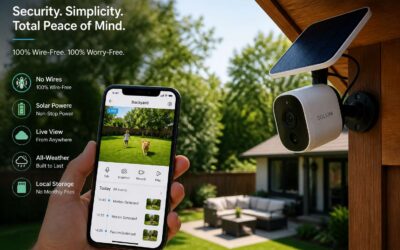
What is a Solar-Powered Surveillance Camera? It is a compact device pairing a photovoltaic panel with a camera and storage, letting it operate without tethered power. Its secret is a smart battery and energy management, giving crisp footage when darkness falls and a lightweight, weather-hardy profile fit for our climate.
- Self-charging power from the sun
- Weather-resistant build for rain and heat
- Remote viewing and motion alerts
Key Components of a Solar-Powered System
South Africa basks in about 2,500 hours of sunshine each year, turning rooftops into quiet power plants. Understand how a solar panel security camera stays vigilant through heat and night: it blends a compact camera with a clever energy system that never truly rests!
- Photovoltaic panel: harvests daylight with durable glass and anti-glare coating.
- Charge controller: modulates current to protect the battery and optimize energy flow.
- Battery bank: stores daytime surplus for night and overcast days.
- Data link and storage: camera memory plus wireless or wired transmission to remote viewing.
Beyond the panel and battery, a weather-resistant housing and smart energy management keep the system humming in scorching sun or blistering rain. Uninterrupted footage and a quiet resilience define every interval.
How the Solar Panel Charges the Battery
Sun-soaked South Africa yields a steady advantage for security—roughly 2,500 hours of sunshine a year, enough to turn every rooftop into a vigilant observer. A solar panel security camera doesn’t sleep; it converts daylight into a watching presence that stays on long after dusk.
During the day, photons kiss the photovoltaic panel, made for harsh sun and glare resistance. The charge controller modulates the current, protecting the battery and steering energy to the camera as needed. A storage bank holds surplus power for night and cloudy days, ensuring uninterrupted footage.
To visualize the cycle:
- Daylight is harvested and converted
- The controller regulates current and prevents depletion
- The battery supplies the camera when light fades
Backed by sturdy weatherproof housings and smart energy management, these devices stay ready through heat and rain, keeping footage steady when it matters most.
Performance Across Weather and Seasons
In South Africa, where the sun delivers roughly 2,500 hours of sunshine a year, a solar panel security camera quietly tethers security to the hours of daylight. Across seasons, it shows that coverage isn’t about fixed clocks—it’s about letting light do the heavy lifting and staying vigilant from dawn through dusk.
To understand its performance across weather and seasons, consider these realities:
- Sun angle and daylight duration shape energy harvest.
- Cloud cover and storms test endurance, while storage buffers the footage.
- Ambient temperature and heat influence battery efficiency, mitigated by smart design.
That resilience defines the device’s character, turning variable weather into dependable surveillance. Through hot SA summers and misty mornings, robust housings and thoughtful energy management keep footage flowing when it matters most.
Benefits and Limitations of Solar-Powered Cameras
Energy Independence and Low Maintenance
Sunlight is a steadfast partner, turning worry into watchfulness. In South Africa’s rural spaces, a solar panel security camera acts as a silent sentinel—independent of grid outages—and delivers crisp footage when it matters most, a quiet testament to resilience in the harsh midday heat.
- Energy independence means ongoing monitoring during load shedding and outages.
- Low maintenance design reduces field visits, downtime, and wear on equipment.
- Long-term cost savings come from minimal fuel needs and fewer service calls.
Limitations exist: reliance on sun means cloudy spells or short winter days can strain battery reserves, so ample storage or backup power helps. Pairing sturdy mounting, weatherproof housings, and tamper resistance keeps a street-smart guardian standing watch through storms and dust.
Limitations to Consider: Sunlight, Battery Health, and Connectivity
South Africa’s sunny days are abundant, but load shedding isn’t generous with its timing. A solar panel security camera is your silent sentinel—independent of the grid and delivering crisp footage when it matters most. It offers hands-off reliability, longer uptime, and fewer on-site visits, turning chaos into calm and giving you a watchful edge in the middle of a heat-filled day.
Limitations to consider revolve around sunlight, battery health, and connectivity. Even on bright days, clouds or short winter days can drain storage unless capacity is generous or backup power is in place. Battery health matters for longevity and runtime, while rural SA connectivity can influence remote access.
- Sunlight variability and storage planning
- Battery health and cycle life
- Connectivity and data access
Cost Benefits Over Time
Sunlight is a steady ally in South Africa, but outages and soaring tariffs steal the moment. Over 70% of rural SA homes faced at least one blackout last year, a fact that reframes security from a luxury into a quiet, essential shield. A solar panel security camera drinks the sun’s energy and returns it as reliable footage, turning daylight into uptime and reducing dependence on the grid.
Over time, the cost benefits accrue: ongoing energy costs disappear from the ledger, maintenance shrinks to a few annual checks, and uptime compounds as batteries settle into their rhythm. The caveat is the upfront investment and the life-cycle cost of replacements; still, ROI tilts in favor of independence when outages loom and remote monitoring is desired.
Best Environments for Solar-Powered Surveillance
In South Africa, where last year 70% of rural homes faced at least one blackout, a solar panel security camera stands as a quiet guardian. It delivers dependable footage by harvesting daylight, yet it isn’t magical—shadows, battery wear, and variable weather can temper uptime.
Benefits include steady surveillance, lower running costs, and reduced grid dependence. Limitations remind us that placement and maintenance matter; a well-aimed camera still needs sun on its panel and a healthy battery to outlast a season of storms.
Best environments for solar-powered surveillance include:
- Rooftops or elevated positions with direct sun for most of the day
- Open perimeters on fences with minimal shading
- Rural properties where line-of-sight and long battery life are advantageous
Choosing the Right Solar-Powered Security Camera for Your Property
Assessing Power Needs and Battery Capacity
Sunlight is a tireless ally, and in South Africa’s radiant mornings, it powers more than just gardens—it powers security. A faithful security companion can be your property’s quiet guardian from dawn until dusk. I’ve seen this approach turn a quiet street into a watched, humming corridor. As you choose, you balance how much energy the camera needs with how much the battery can store to keep footage rolling on cloudy days.
- Estimate daily power draw from resolution and motion activation.
- Assess local sun hours and seasonal shifts for sizing.
- Choose a battery with usable capacity for cloudy days.
- Pair with a solar panel wattage that recharges in daylight.
When you find the right solar panel security camera, it feels like gifting your property a vigilant sunlit guardian.
Camera Features to Consider: Resolution, Night Vision, and Storage
The solar panel security camera is more than a lens—it’s a sunlit witness, standing guard over South Africa’s quiet wards with quiet, timeless patience. When one prioritizes crisp resolution, reliable night vision, and practical storage, clarity arrives even as dusk falls. Models scale from 1080p to 4K, with HDR to reveal details in high-contrast scenes.
- Resolution: options from 1080p to 4K for sharp identification
- Night vision: infrared range and smart exposure for low-light scenes
- Storage: local microSD and encrypted cloud backups for flexibility
Storage isn’t merely capacity; it’s the promise of evidence that won’t vanish in a storm. Look for motion-triggered recording, efficient compression, and a mix of on-device and cloud options so clips stay accessible even if one path falters.
Mounting Options and Weather Resistance
Choosing the right solar panel security camera isn’t merely about what you see; it’s about what endures when SA’s sun bakes the veld and sudden storms roll in from the coast. A solar panel security camera stays crisp from dawn to dusk, becoming a steadfast witness—quiet, patient, and always alert.
Mounting options matter as much as the lens, shaping how much of the property you keep in view. Consider these configurations:
- Roof or eave mounts for optimal sun exposure
- Pole or mast mounts for elevated coverage and wide angles
- Wall mounts on sturdy exterior surfaces for a discreet profile
Weather resistance is the quiet backbone of reliability: seek rugged housings with UV stability, dust seals for parched Karoo dust, rain ratings for coastal spray, and seals that stand up to gusty coastal winds. When climate tests you, the camera endures.
Brand Reputation, Warranties, and Support
Brand reputation isn’t lipstick on a product. It’s proof in the field: uptime, real-world service, and clear warranty terms. A solar panel security camera from a trusted maker carries a proven track record and a network of local partners that diagnose issues fast. In South Africa, that translates to quicker parts, faster repairs, and less downtime when it matters most.
Warranty depth and what it covers matter as much as the device’s features. Seek hardware guarantees that include the solar panel, battery health, and sensor modules, plus a straightforward claims path. Verify regional support—local technicians, spare parts availability, and reasonable response times. Transparent service levels save time and money when a fault pops up.
- Clear warranty terms including solar and battery coverage
- Local SA support with regional technicians or fast parts access
- Accessible updates, spare parts, and documented service SLAs
Installation Guide and Setup Best Practices
Site Selection and Sun Exposure Optimization
Across South Africa, roughly 60% of security incidents unfold after dusk, turning twilight into a tipping point. A solar panel security camera shifts the balance, delivering tireless watchfulness as the sun feeds its power. Installation is not flashy; it is a quiet covenant between light, lens, and landscape.
Installation Guide and Setup Best Practices begin with a site evaluation: a sturdy mount, tamper resistance, and weatherproofing for wiring. Position the unit to cover primary entrances with clear sight lines, while design choices keep the system resilient under wind and rain. The solar panel security camera embodies quiet reliability.
Site Selection and Sun Exposure Optimization: Favor a north-facing orientation in South Africa to maximize solar input, and select a location free from shade throughout the day. The balance of light and lens creates steady performance, even as seasons shift and daylight wanes.
Mounting, Wiring, and Safety Steps
Across South Africa, roughly 60% of security incidents unfold after dusk, and a solar panel security camera changes the math—perpetual vigilance without a power cord. Installation isn’t fireworks; it blends with the landscape and keeps eyes on entry points.
Best practices here steer away from bravado and toward durability: mounting in discreet, stable locations, tidy cable management, and safety-minded wiring that respects rain and wind while preserving aesthetics.
- Mounting considerations that deter tampering
- Discreet routing and strain relief for cables
- Weatherproof enclosures and seals for long life
- Compliance with local codes and privacy guidelines
The result is a quiet, resilient vigil that outlasts the day and remains unfussy when storms roll in.
Initial Setup: App, Connectivity, and Firmware
Across South Africa, roughly 60% of security incidents unfold after dusk. I peer into the quiet interface that governs a solar panel security camera from dawn to dusk, a reminder that power reliability is as much a mindset as a wattage. The setup isn’t a sprint but a careful alignment of app onboarding, device pairing, and firmware cadence—a choreography where cloud accounts, encryption, and local storage converge. In SA’s neighborhoods, robust connectivity—preferably dual-band Wi‑Fi with a fallback—makes the difference between a gaze that wanders and a vigil that endures.
Considerations guide the configuration more than steps:
- App onboarding and account security that guards footage and credentials
- Connectivity choices balancing reliability, data usage, and latency
- Firmware cadence and automatic updates to patch vulnerabilities
These choices shape a device that remains watchful without intruding on the landscape.
Maintenance and Troubleshooting Common Issues
Across South Africa, security incidents rise by 60% after dusk, and a well-tuned solar panel security camera becomes a patient witness in the gathering dark. Installation is a ritual of balance rather than a rush—a careful alignment of sun, shelter, and signal. The aim is a device that endures wind and glare while remaining unobtrusive in the neighborhood canvas. It’s a choreography of mounting, power budgeting, and cloud-verified trust.
Consider these setup best practices in a single breath:
- Assess sun exposure and wind load for optimal orientation
- Choose weatherproof mounting and protected cable routes
- Ensure robust connectivity with dual-band support
- Configure app credentials and encrypted storage for privacy
These choices reinforce reliability without cluttering the landscape.
Maintenance and troubleshooting hinge on listening to the device’s cadence. Monitor the system’s heartbeat—panels, battery health, and firmware cadence—and treat anomalies as signals to revisit power, connectivity, and storage integrity rather than quick fixes.
Security, Privacy, and Network Considerations
Data Storage Options: Cloud vs Local
“In the data age, trust is the first line of defense.” Security, privacy, and reliable connectivity are not afterthoughts—they are the backbone of any solar panel security camera system. Footage travels quickly across networks, and the storage choice shapes who can access it and when.
Cloud storage offers scalability and remote viewing, but data travels beyond your local perimeter. Encrypt data in transit and at rest, enforce strong authentication, and favour suppliers that honour data sovereignty under South Africa’s POPIA. For a solar panel security camera, cloud storage raises the privacy bar.
Consider these options:
- Cloud storage: scalable backups, remote access, and simple sharing for your solar panel security camera.
- Local storage: complete control, faster retrieval, and no ongoing monthly fees.
- Hybrid approach: a middle ground that preserves privacy while enabling cloud redundancy.
With network settings tuned, your footage remains a quiet guardian rather than a loud announcement.
Protecting Camera Access and Firmware from Hackers
Cybercrime remains a fast-moving threat in South Africa, and every unguarded access point becomes an invitation for mischief. For a solar panel security camera, protecting camera access and firmware from hackers means guarding the channels that carry footage—through encryption, strong authentication, and a verified update path. Firmware integrity checks and trusted sign-offs turn the act of updating into a quiet covenant between device and service, not a weak link in your perimeter.
Consider these security pillars as you design the network for resilience.
- Data encryption in transit and at rest, plus access control
- Signed firmware updates and secure boot to verify authenticity
- Network segmentation and continuous monitoring to spot anomalies
When these systems talk, the solar panel security camera stays a silent witness rather than a compromised gateway.
Privacy Compliance and Public Space Ethics
South Africa faced a 23% rise in cybercrime last year, turning every unguarded corner into a siren. A solar panel security camera acts as a quiet guardian, watching through the night with restrained, almost ceremonial calm, weaving encryption and ethics into the air between us and the unknown.
Privacy compliance and public space ethics are not afterthoughts but the spine of responsible surveillance. In public areas, transparency and lawful data handling build trust with communities, allowing the camera to protect property while respecting the rights and dignity of people nearby.
When these principles glow in design, the device remains a sentinel—watchful yet unobtrusive, a figure in the South African night that guards without gripping the gaze, turning surveillance into a measured, humane act rather than a shadowy intrusion.
Best Practices for Network Security and Updates
Security headlines across South Africa remind us that calm isn’t compliance; cybercrime rose 23% last year, turning quiet corners into risks, and I see how a solar panel security camera embodies a measured philosophy—watchful, unobtrusive, and built to protect property while respecting privacy.
- Strong, unique credentials combined with multi-factor authentication for device and cloud access.
- Encrypted connections and minimized exposure by turning off unused services.
- Network segmentation and restricted admin access to limit pathways for intruders.
- Regular log review and anomaly monitoring to spot threats early.
For a solar panel security camera, automatic firmware updates from trusted channels are non-negotiable; pair them with encrypted connections, network segmentation, and vigilant log monitoring.
Model Comparisons and Budgeting for Solar Cameras
Budget-Friendly Models with Essential Features
Power has a stubborn side in South Africa—outages and rising costs demand vigilance that doesn’t buckle at dusk. When evaluating a solar panel security camera, the ledger matters as much as the lens: a dependable solar charging system, solid weather sealing, and a forgiving price tag can outpace flashier but fragile rivals. Model comparisons reveal budget-friendly options now deliver credible security without compromise.
Budget-friendly models with essential features include:
- HD or better resolution for clear detail
- Infrared night vision with wide illumination range
- Efficient solar charging and energy storage for steady uptime
- Weatherproof housing and tamper resistance
As you budget, weigh upfront cost against maintenance, data options, and service. In SA’s sun-soaked environment, energy independence can trim long-term expenses while keeping vigilance intact, even when the grid winks out.
Mid-Range Cameras with Advanced Capabilities
Across SA, the adoption of solar panel security camera setups is rising about 25% annually, a hedge against an unreliable grid and rising power costs. Model comparisons show mid-range cameras with advanced capabilities delivering credible security without the premium price tag.
When you tilt toward mid-range options, consider these features that punch above their weight:
- 1080p or better resolution for crisp detail
- Infrared night vision with extended range
- Efficient solar charging and storage to maintain uptime
Budgeting wise, weigh upfront cost against maintenance, data options, and service plans. In South Africa’s sun-drenched environment, energy independence isn’t a luxury—it’s a practical shield that keeps the system humming even when the grid winks out.
Premium Options: Durability and Extended Warranties
In South Africa, premium solar panel security camera setups outpace budget kits, delivering reliable surveillance when the grid falters and the sun bakes. Choose durability and extended coverage, and you trade uncertainty for steady uptime, crisp detail, and the quiet confidence of protection that doesn’t quit at dusk.
- IP66 or IP67 weather sealing
- IK10 vandal resistance
- Wide operating temperature range: -20°C to 60°C
- Corrosion-resistant housing
- Efficient solar charging with a robust battery bank
Upfront price versus maintenance, data options, and service plans shape premium choices. In South Africa’s sun-drenched climate, energy independence is a practical shield, and premium durability paired with extended warranties often yields lower total risk for a solar panel security camera.
Cost of Ownership: Power, Maintenance, and Replacement
Power outages cast long shadows across South Africa, but a solar panel security camera rises like a lighthouse on the veld. When the grid falters, this sun-fed sentinel keeps watch and footage crisp. Model comparisons unfold as a choreographic poem: weigh battery depth, solar charging efficiency, and resilience against rain and heat.
Before you buy, map the total cost of ownership: Power needs, maintenance cadence, and replacement cycles shape fate more than sticker price.
- Upfront cost versus ongoing maintenance
- Battery health and replacement timelines
- Warranty coverage and support plans
In SA’s sun-drenched climate, energy independence isn’t an aspiration—it’s a shield. A solar panel security camera thrives on sun and strategy, and the savvy buyer negotiates data options, service plans, and vendor support to minimize downtime and maximize uptime.
0 Comments