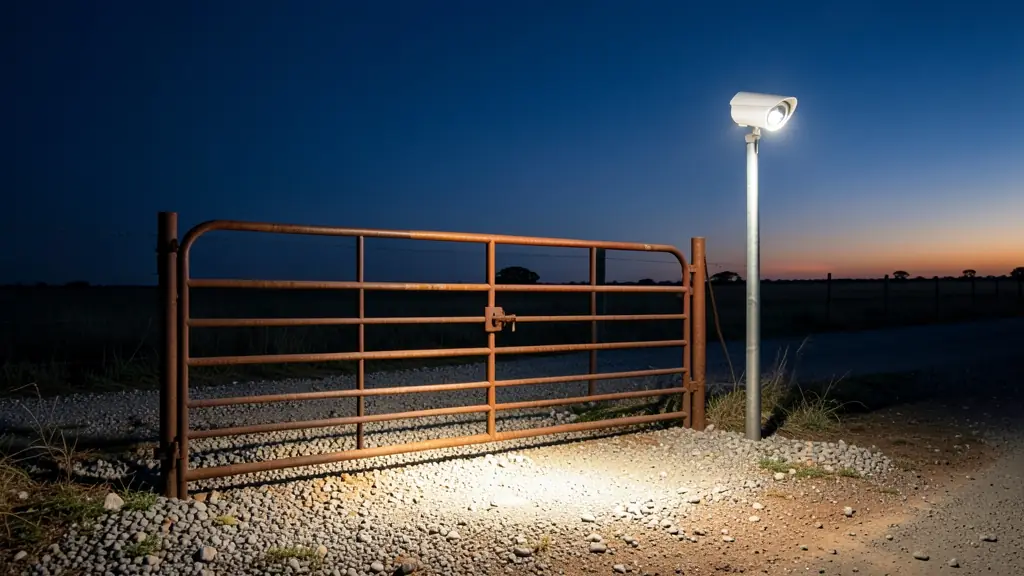
Most break ins happen when it is dark, so security camera night vision matters more than any daytime spec. There are three ways a camera sees at night: its own infrared light in black and white, a small white light that keeps the picture in colour, or a sensitive starlight sensor that makes do with a street lamp. Each fails differently. Here is which suits a yard, a street front or a farm gate, and the small fixes that rescue a ruined picture.
IR, colour and starlight compared
- IR night vision: invisible infrared LEDs flood the scene and the camera switches to black and white. Reliable, but clothing and car colours are lost.
- Colour night vision: a warm white light comes on so the camera keeps colour. It also acts as a light that tells an intruder they are seen.
- Starlight sensors: a larger sensor and a wide aperture that pull colour out of street light or moonlight, with IR as the backup when it is truly black.
- Smart hybrid light: IR by default, and the white light switches on only when a person or vehicle is detected.
How far it really sees
IR on a bullet usually reaches about 20 to 40 metres, and on a small dome noticeably less. That figure is where the light fades, not where a face is still readable. Beyond the lit zone a camera records shapes. Light the area you care about: an outside light by the gate helps every camera more than a bigger IR number. A PoE camera that runs IR or a white light all night draws more power, so check the switch and UPS in the PoE power budget calculator.
Why the picture turns white or foggy
IR bounces. Aim a camera too close to an eave, a gutter or a side wall and the light reflects straight back into the lens, so the near half of the frame goes white and the yard stays dark. Tilt the camera down and away from the surface. A spider web across the lens glows in IR, wobbles in the wind and fires motion alerts until dawn. Headlights and a bright street lamp in frame blind the sensor. If it suddenly stopped working, see camera repairs.
No glow IR and where it fits
Standard IR LEDs show a faint red glow. No glow IR (940 nm) is fully invisible, which suits a stock room, a farm shed or a game camera, but it reaches a shorter distance and the picture is darker. For most homes a visible camera is part of the deterrent, so the glow is no loss. Pair it with the right shape from dome and bullet cameras.
What to put in your request
- Say which spots are pitch dark at night
- Mention street lights or headlights in view
- Say whether colour at night matters to you
- Send a night photo or short video of the yard
- Ask how the cameras keep running in load shedding
Night Vision Cameras: who asks for them and why
- Freestanding houses: a hybrid light camera on the driveway and IR along the dark side passage to the back
- Flats, townhouses and complexes: starlight cameras on the parking lot lit by the lamps along the complex roads
- Shops, salons and restaurants: colour night vision over the back door where stock goes missing after closing time
- Offices and practices: IR in the parking area after hours, tilted clear of the low roof overhang
- Warehouses, workshops and yards: starlight cameras across the yard lights and IR along the dark rear fence
- Farms and smallholdings: a camera with white light at the diesel tank so a thief knows the tank is watched
- Schools, churches and clubs: IR on the field fence and hybrid light at the gate after the last evening event
- Building and temporary sites: colour cameras with a floodlight on the container so copper thieves can be identified