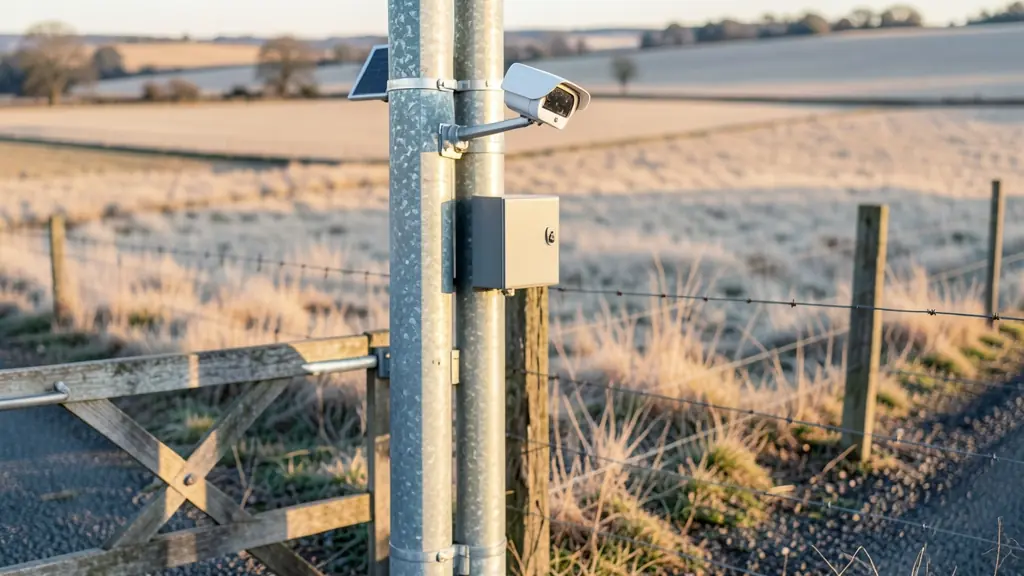
A CCTV camera mounting pole or a good bracket decides what the camera sees and how long it stays pointed there. A farm gate 400 m from the house has no wall to fix to; a townhouse eave can cut the parking bay out of the picture; a Ballito building site has only a container. Here is the hardware that holds a camera up.
Wall, corner and pole brackets
- Wall brackets stand the camera off the wall so it looks along it, not into the brick. Fix into brick, not mortar, with stainless screws that will not bleed rust.
- Corner brackets fit an outside corner of the house, so one camera covers two sides, such as the side passage and the back yard.
- Pole brackets clamp to a round or square pole with stainless bands.
- Extension arms push the camera out from under a deep eave or stoep roof, so the overhang leaves the frame and rain misses the lens.
The security camera junction box: a home for the joins
Most cameras come with a short tail of wires and plugs. Taped and left hanging, they corrode in the first rainy season. A security camera junction box made for that camera's base sits between camera and wall, keeps the connectors dry, and hides the cable so nobody can snip it from below. Match the box to the camera's screw pattern, and seal the cable entry with a gland, not silicone smeared on afterwards.
A steel pole for a CCTV camera at gates and yards
Where there is no wall, a security camera pole gives the height. For a farm gate, a warehouse yard or an estate entrance, installers usually use galvanised steel, concreted into the ground or bolted to a base plate on a slab. A thin pole sways in wind and the night picture smears; a heavier pole or a stay steadies it. Run the cable inside, cap the top and lock the bottom hatch. A solar camera's pole also carries the panel, which must face north and stay out of shade, see solar security cameras.
How high to mount, and what height changes
Out of reach is the rule: someone standing on the wall or a wheelie bin should not touch the camera. Go too high and you record scalps and caps, not faces. For a face at a gate, a lower camera with a longer lens, set back a few metres, often beats one on the gutter. Check the view in the lens field of view calculator before you drill. Shapes mount differently (dome and bullet cameras), and a PTZ camera on a pole needs a heavier bracket for its weight.
What to put in your request
- Say wall, corner, eave or pole for each
- Send photos of every mount spot
- Say the wall: face brick, plaster or steel
- Give the distance out to the far gate
- Mention strong wind or a site near the sea
Security Camera Mounts and Poles: who asks for them and why
- Freestanding houses: corner brackets on the house and an arm under the eave to clear the gutter
- Flats, townhouses and complexes: low profile brackets painted to match, approved by the body corporate before fitting
- Shops, salons and restaurants: a bracket high over the back door, out of reach from a crate or a bin
- Offices and practices: ceiling mounts in reception and a wall bracket facing the staff parking
- Warehouses, workshops and yards: heavy pole brackets in the yard and clamps on steel columns above the loading bay
- Farms and smallholdings: a galvanised pole concreted in at the far gate, carrying a camera and a panel
- Schools, churches and clubs: tall wall mounts at the gate and the hall, well above a learner's reach
- Building and temporary sites: a clamped mount on the container and a temporary pole that moves with the build