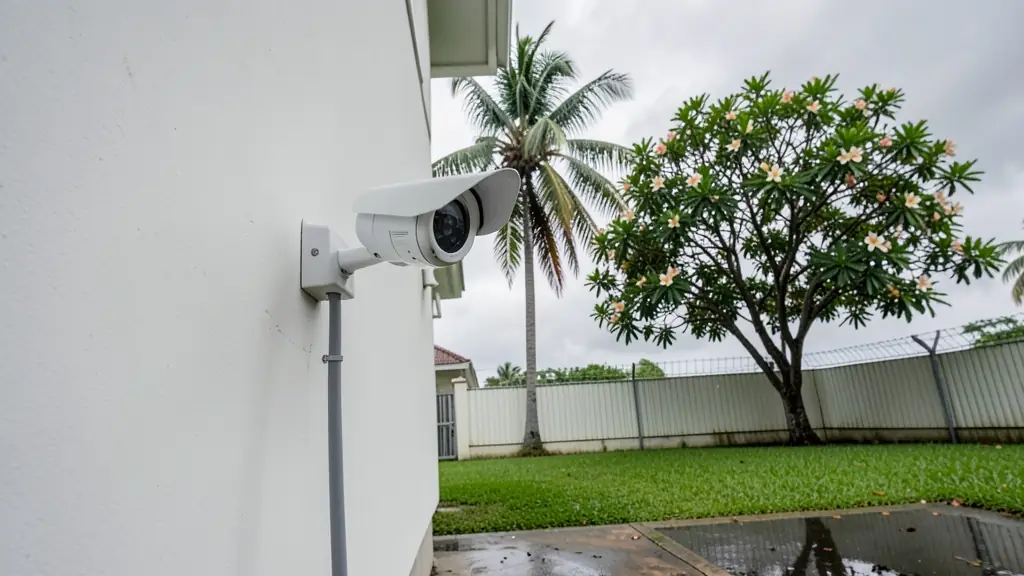
An outdoor camera has a harder life than any other piece of your security: January sun on the north wall, a Highveld hailstorm in November, dust off the gravel road and spiders that move in the first week. Picking one is less about pixels and more about whether it is sealed, mounted at the right height and pointed where the light will not blind it. Here is what an installer looks at before fixing one to your wall.
Ratings that matter on a security camera for outside
- IP66 or IP67: sealed against dust and driven rain. IP66 is the sensible floor for anything under an open sky.
- IK10: a vandal rated housing that takes a hard knock. Worth paying for on a dome within reach of a ladder or a thrown brick.
- Operating temperature: a black housing on a west wall can bake. Check the upper limit on the data sheet and prefer a white or light grey body.
- A sun hood on bullets keeps rain off the glass and cuts glare.
Hail rarely breaks a good housing, but it does snap cheap plastic brackets and dislodge loose cable.
Height, angle and the light problem
About 2.5 to 3 m up is the usual sweet spot. Higher, and a burglar's cap peak hides his whole face; lower, and a broom handle knocks the camera askew. Tilt it so the horizon sits near the top of the picture. Never aim straight into the rising or setting sun, and keep the gate camera from staring into the headlights of cars turning in, or every night clip turns white. Under an eave, leave a gap so the IR does not bounce back off the soffit. Measure from the wall to the gate, then let the field of view tool say whether 2.8 mm will do or the gate needs 6 mm.
Protecting the cable and the connection
The camera is usually fine. The weak point is the joint behind it, where a plug sits in the open and fills with water. A junction box under the camera hides the plug, and UV rated cable in conduit along the wall stops it cracking in the sun. Cable left loose on the ground gets cut by the gardener's strimmer. Ask how the installer seals every hole drilled through the wall.
Outdoor camera security after dark
A yard lit by a sensor floodlight helps colour night vision. Webs across the lens trigger motion alerts all night, so a quick wipe and a dab of insect repellent on the housing every few months saves a lot of false alerts. For the trade offs of IR and colour see night vision cameras.
What to put in your request
- Say which walls face the morning and evening sun
- Send photos of the eaves and the gate
- Mark how far the gate is from the house
- Say if there is power or WiFi on each side
- Ask how holes and joints will be sealed
Outdoor Security Cameras: who asks for them and why
- Freestanding houses: bullets under the eaves on the driveway and the back yard, and a vandal dome at the gate
- Flats, townhouses and complexes: a camera over your own patio and parking bay, approved by the body corporate first
- Shops, salons and restaurants: a vandal dome over the back door and the loading lane where stock goes out
- Offices and practices: cameras on the parking area and the visitors' entrance, aimed away from the street
- Warehouses, workshops and yards: long lens bullets along the fence line and over the yard where trucks turn
- Farms and smallholdings: sealed cameras on the workshop, the diesel tank and the yard, built for dust
- Schools, churches and clubs: cameras on the gate at drop off and the field fence, kept away from changerooms
- Building and temporary sites: cameras high on the container and the stores, with cable kept off the ground