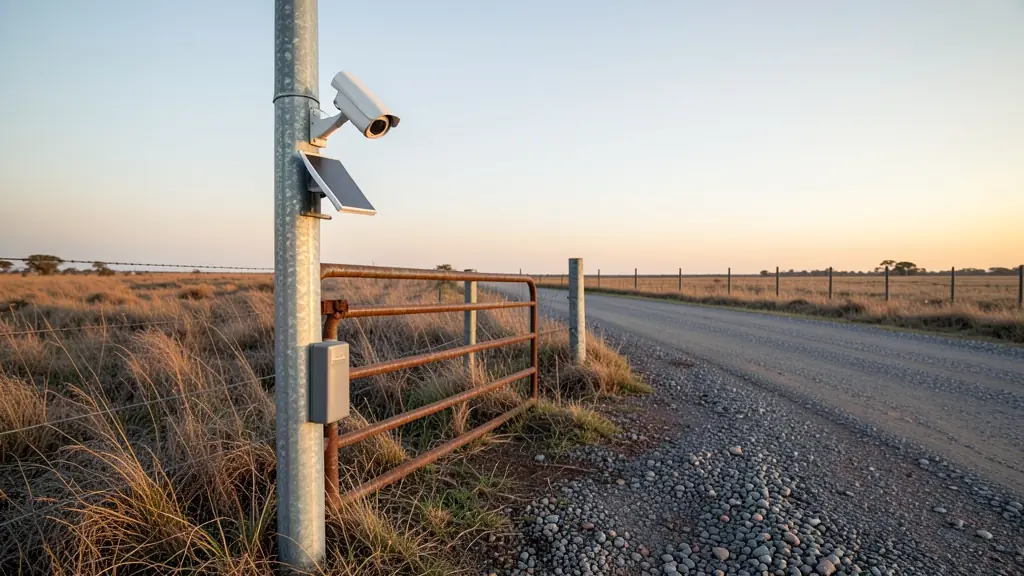
A solar security camera carries its own power station: a panel, a battery and a camera that sips power so it can record through the night. It earns its place where running mains is expensive or impossible, such as a farm gate 800 m from the house, a building site before the power is connected or a borehole pump in the veld. It also keeps recording through load shedding without a UPS. The catch is sizing. Too small a panel works fine in summer and goes dark on the third cloudy day in June.
Where a solar cctv camera makes sense
- Far gates and farm roads, where trenching cable would cost more than the camera.
- Building sites with a container full of copper and tools and no power at night.
- A diesel tank, a pump or a stock kraal away from the yard.
- Holiday homes that sit empty for months.
Close to the house with a plug point nearby, a mains camera on a UPS is usually cheaper and gives a steadier picture.
Sizing the panel and the battery
Work from the camera's watts, the hours it runs and how many sunless days it must survive. A camera that sleeps and wakes on motion needs far less than one that records all the time with IR on all night. Winter in the Highveld gives fewer useful sun hours than December in Upington, so size for June, not for the day you install it. Ask the supplier for the battery's Ah and how many days of autonomy it gives. The solar camera power calculator turns your numbers into panel watts and battery size.
Angle, shade and keeping the panel clean
In South Africa the panel faces north, tilted fairly steeply so it catches the low winter sun. A gum tree that throws shade at 2 pm, or a layer of dust from the farm road, can halve what it delivers. A wipe every month or two in the dry season helps. Bird droppings on one corner matter more than you would think.
Solar wifi camera or 4G, and theft
A solar wifi camera only works if a strong WiFi signal reaches the pole, often with a point to point link from the house. Further out, a 4G camera with a SIM card sends clips over a mobile network, and live viewing uses the most data. Panels get stolen, so mount everything high on a steel pole, use anti theft bolts and let the camera watch its own panel. A proper pole and bracket also stops wind from swinging the picture.
What to put in your request
- Say how far the spot is from the house
- Say whether there is WiFi or cell signal there
- Mention trees or buildings that cast shade
- Say whether you will watch live often
- Ask how the panel will be protected from theft
Solar Security Cameras: who asks for them and why
- Freestanding houses: a solar camera on the far back wall or the gate where no plug point exists
- Flats, townhouses and complexes: a camera on the perimeter fence far from the guardhouse, without a trench
- Shops, salons and restaurants: rarely needed, though a solar camera can watch a separate storeroom across the yard
- Offices and practices: a camera on a remote parking lot or a back gate where cable is costly
- Warehouses, workshops and yards: cameras on the far fence corners of a big yard, away from the building's power
- Farms and smallholdings: a camera on the far gate, the diesel tank and the kraal, linked by 4G
- Schools, churches and clubs: a solar camera over the sports field gate at the far end of the grounds
- Building and temporary sites: cameras on the container and the stores from day one, before power is connected