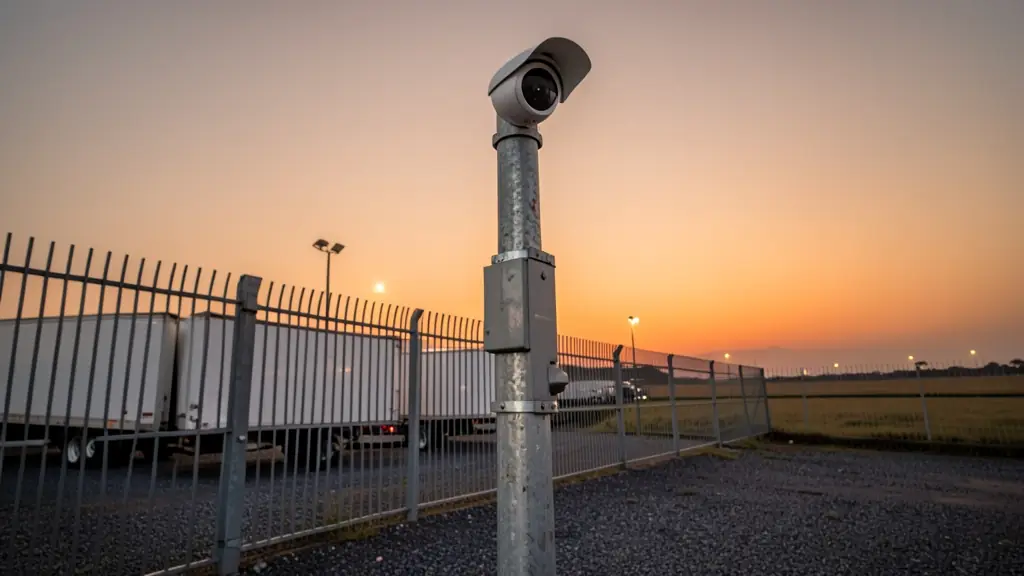
A PTZ camera can turn left and right (pan), look up and down (tilt) and zoom in on something far away, all from the camera's app or the recorder. On a truck yard in Pomona or a smallholding outside Cullinan, one PTZ on a pole can follow a person across ground that would otherwise need several fixed cameras. The catch is simple: while it looks one way, it sees nothing behind it.
PTZ camera meaning: optical zoom versus digital zoom
The figure that matters on a PTZ is the optical zoom, written as 4x, 25x or 32x. Optical zoom moves glass inside the lens, so something 100 m away can still show useful detail. Digital zoom only enlarges pixels you already have, and it turns blocky quickly. Get the optical figure in writing and test it at your distance with the lens and field of view calculator.
Auto tracking, patrol presets and the gap they leave
Most PTZs store presets: the gate, the diesel tank, the workshop door. Auto tracking locks onto a person or vehicle and follows it with the zoom. Both are useful, and both leave a hole: while the camera is zoomed on the gate, a second person at the back fence goes unrecorded. That is why installers pair a PTZ with fixed cameras that watch the main points all the time. Wind blown grass and dogs can fool tracking, so expect some tuning.
Power, poles and wind
A big PTZ with strong IR and a heater draws far more than an ordinary camera, often more than a standard PoE port supplies, so it may need a high power port or its own supply. Add it up in the PoE power budget calculator before you choose the switch and the UPS for load shedding. Outdoors it wants a stiff steel pole concreted in, a proper bracket and a junction box for the connections; a thin pole that sways in a Highveld storm turns zoomed footage into a blur. In open veld, ask about surge protection too.
WiFi PTZ cameras for homes
The small white cameras that swivel on a round base are PTZs too, on a much smaller scale. A wifi PTZ camera suits a yard you want to look around from your phone: the pool, the dogs, the back gate. They usually have little or no optical zoom, and they rely on strong WiFi at the camera. Fine for checking in, not for reading plates.
What to put in your request
- Say what the PTZ must watch and how far
- Say whether it goes on a pole or a wall
- Mention power and network near the spot
- Say if someone will watch it live
- List the fixed cameras you already have
PTZ Cameras: who asks for them and why
- Freestanding houses: a small wifi PTZ looking over a large yard, the pool and the back wall
- Flats, townhouses and complexes: a PTZ at the guardhouse following cars from the boom gate to the parking
- Shops, salons and restaurants: rarely needed, though a large retail parking area can use one on a pole
- Offices and practices: a PTZ on a roof corner watching the parking and the perimeter after hours
- Warehouses, workshops and yards: a pole PTZ over the truck yard, zooming on loading bays and the main gate
- Farms and smallholdings: a PTZ on a pole near the house, preset on the diesel tank, kraal and workshop
- Schools, churches and clubs: a PTZ over the sports fields, with fixed cameras kept on the gate at drop off
- Building and temporary sites: a PTZ on a mast over the site, tracking movement near the container at night