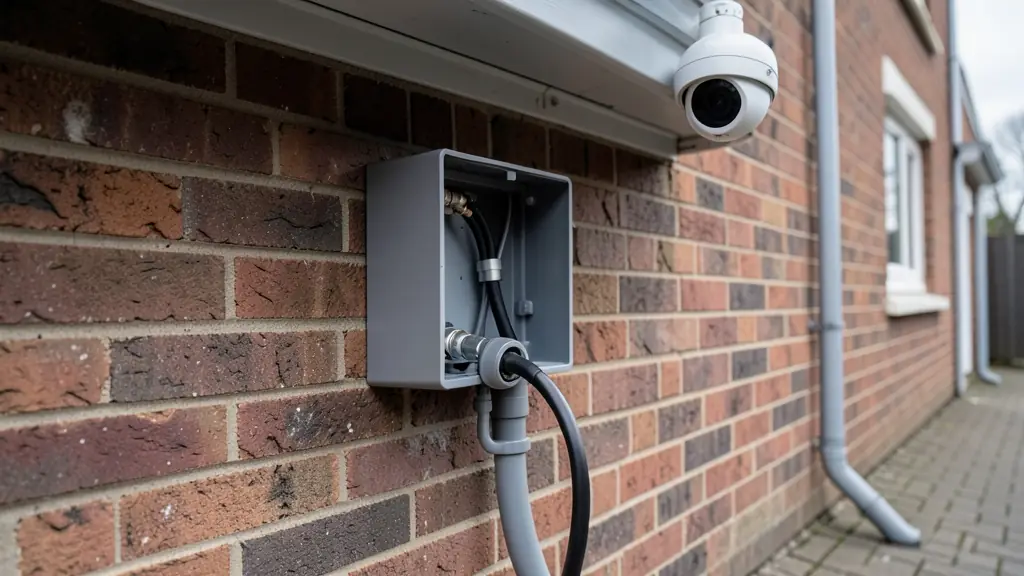
The security camera cable is the part of a system nobody photographs and the part behind most call outs. A camera that drops off every evening or a power supply that cooks in the ceiling in January is a cable or power fault, not a camera fault. Here is what to buy, whether you are wiring a new house in Centurion or fixing an old run on a smallholding.
Cat6: solid copper, and the outdoor kind
For IP cameras, one Cat6 run carries power and video up to about 100 m. Buy solid copper, not copper clad aluminium (CCA). Over a long run CCA loses enough voltage that the camera restarts when its IR comes on at dusk. Scratch the cut end: real copper stays copper coloured. Indoor cable has a grey or blue jacket that cracks after a few summers in the sun, so anything along a wall, a fence or a roof needs outdoor UV rated cable with a black jacket, or conduit over it.
CCTV camera cable: RG59 siamese for coax systems
HD over coax systems use RG59 siamese: the coax for video bonded to a pair of thin power wires. It stays when old analogue cameras are swapped for HD ones. Look for a copper core and a dense braid, and crimp the BNC plugs rather than twisting on ones that work loose. More in CCTV cameras.
Security camera power supply and PoE for IP cameras
- 12 V power supplies. A plug pack at each camera, or one boxed supply with a fused output per camera. The box is tidier and easy to back up. Leave headroom: IR at night draws more than the daytime figure.
- PoE switches. Count the ports and the total watt budget. Eight ports on a switch that can only feed 60 W will not run eight cameras with IR.
- PoE injectors power one extra camera from an ordinary switch.
Work out the watts and the UPS time in the PoE power budget calculator.
Trunking, conduit, burying and lightning
Indoors, use the roof space or trunking. Outside, use conduit with a sealed end at the camera and a drip loop so water falls off before the hole. To a gate or outbuilding, bury it in conduit deep enough that a spade will not find it, with a draw wire for next time. A long run to a far gate or pole is a path for lightning: fit surge protectors at both ends and earth them, or use fibre on the longest links. Cable left on the ground "for a week" stays there.
What to put in your request
- Say IP cameras on Cat6 or coax cameras
- Give the longest run in metres
- Say which runs are outside or buried
- Count the cameras the supply must power
- Mention any past lightning damage
Security Camera Cables and Power: who asks for them and why
- Freestanding houses: outdoor Cat6 along the eaves and conduit under the paving to the driveway gate camera
- Flats, townhouses and complexes: cable through shared roof space and walls, routed the way the body corporate allows
- Shops, salons and restaurants: trunking along the ceiling to the till camera and a boxed supply on the UPS
- Offices and practices: Cat6 back to a PoE switch in the server cupboard, labelled at both ends
- Warehouses, workshops and yards: long runs over the racking in cable tray, with surge protection out to the yard poles
- Farms and smallholdings: buried conduit to the workshop and fibre or a wireless link out to the far gate
- Schools, churches and clubs: runs to the gate and the hall in conduit, high and out of reach of learners
- Building and temporary sites: temporary outdoor cable strung off the ground on a wire, moved as the build grows