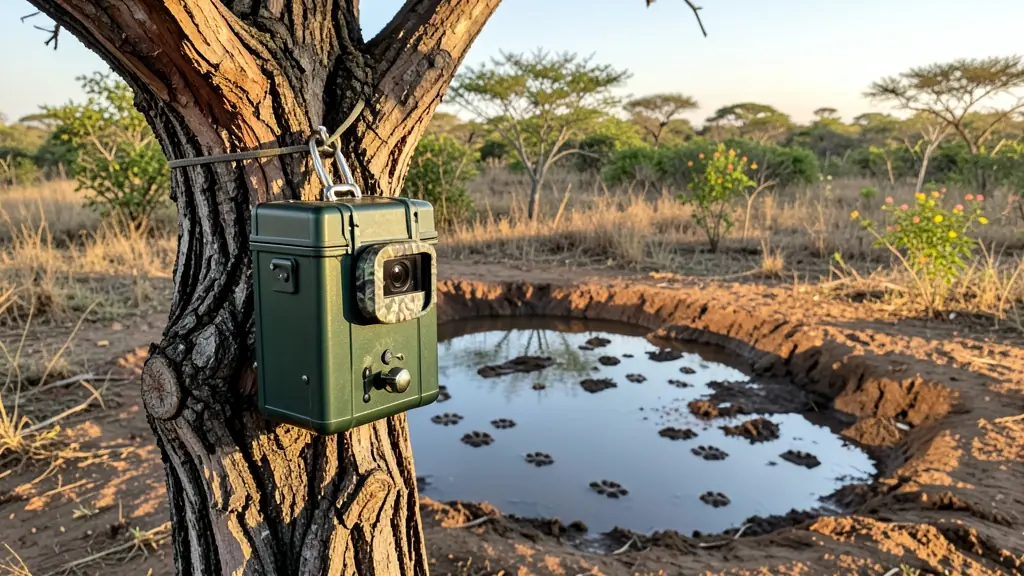
A trail camera is a weatherproof box that straps to a tree or a fence post and sleeps until a warm body moves in front of it, then takes photos or a short video. A game farm near Hoedspruit uses one to count what drinks at the water hole after dark; a sheep farmer in the Eastern Free State uses one on the fence line where ewes go missing. They run for weeks on batteries with no mains and no cable, which suits places nobody visits every day.
Trigger speed, detection range and false shots
The sensor reacts to heat and movement. Trigger speed is the delay before the shot; a slow camera photographs the tail of a kudu, so on a path or a gate look for a fast one. Detection range shrinks on a hot Lowveld afternoon, when the ground is nearly as warm as the animal. Long grass waving in the wind and the sun rising straight into the lens cause hundreds of empty frames, so clear the grass in front and, because the sun tracks across the north here, face the camera roughly south rather than east or west.
No glow IR, low glow and the flash
- No glow: the IR cannot be seen by people or animals, the choice for stock theft and poaching, but night range is shorter and the picture darker.
- Low glow: a faint red glow when it fires, with brighter, longer night pictures; fine for game counts.
- White flash: colour photos at night, but every animal and every thief knows it is there.
For a lit yard or a gate you watch every night, a fixed night vision camera serves better.
Batteries, SD cards and the trail camera with a SIM card
Most run on AA cells; lithium ones last far longer in the cold and the heat than alkaline. A small add on panel makes a solar trail camera that needs fewer visits. A standard model stores photos on an SD card you swap on each round, which means driving out to see what happened. A cellular model takes a SIM and sends each photo to your phone within a minute or two, useful when you want to act on the night, not read about it a week later. Photos use little data compared with video; check yours in the camera bandwidth calculator. For a fixed watch with live view see 4G security cameras.
Baboons, hyenas and people who take cameras
Baboons pull cameras apart out of curiosity, hyenas chew straps and elephants rub on trees. A steel security case with a cable lock or python lock through it solves most of that. People are harder: hide the camera above eye line in a second tree, or put a second camera where it sees the first.
What to put in your request
- Say what you want to catch: game, stock or people
- Say how often someone can visit the camera
- Say if photos must come to your phone
- Say whether baboons or elephants are around
- Say how many spots you want covered
Trail Cameras: who asks for them and why
- Freestanding houses: a camera at the bottom of a big garden to find what digs under the fence
- Flats, townhouses and complexes: a camera on the estate's green belt or river walk where the fence gets cut
- Shops, salons and restaurants: a camera on the back fence of a rural store that has no power out there
- Offices and practices: a camera on a far boundary of a business park where fencing keeps vanishing
- Warehouses, workshops and yards: a camera on the perimeter fence beyond the reach of the main camera system
- Farms and smallholdings: the fence line where sheep go missing, the water hole and the far gate
- Schools, churches and clubs: a camera on an outdoor school's nature trail or a farm school's back fence
- Building and temporary sites: a camera on a pipeline or road route where no power or cable will be for months
Frequently asked questions
How long do trail camera batteries last?
Can a trail camera help with stock theft?
What should I look for in a trail camera for sale?
Who replies to a trail camera request?
Work it out first
- Camera storage calculatorCameras, resolution, codec, hours and days in: the hard drive in TB and the days it keeps out
- Camera bandwidth calculatorCameras, quality and how much you watch in: upload Mbps for remote viewing and GB a month for 4G out
- Lens field of view calculatorLens mm, sensor, resolution and distance in: picture width, pixels per metre and DORI level out